AHA and FFRF file appellate brief against Ark. 10 Commandments monument
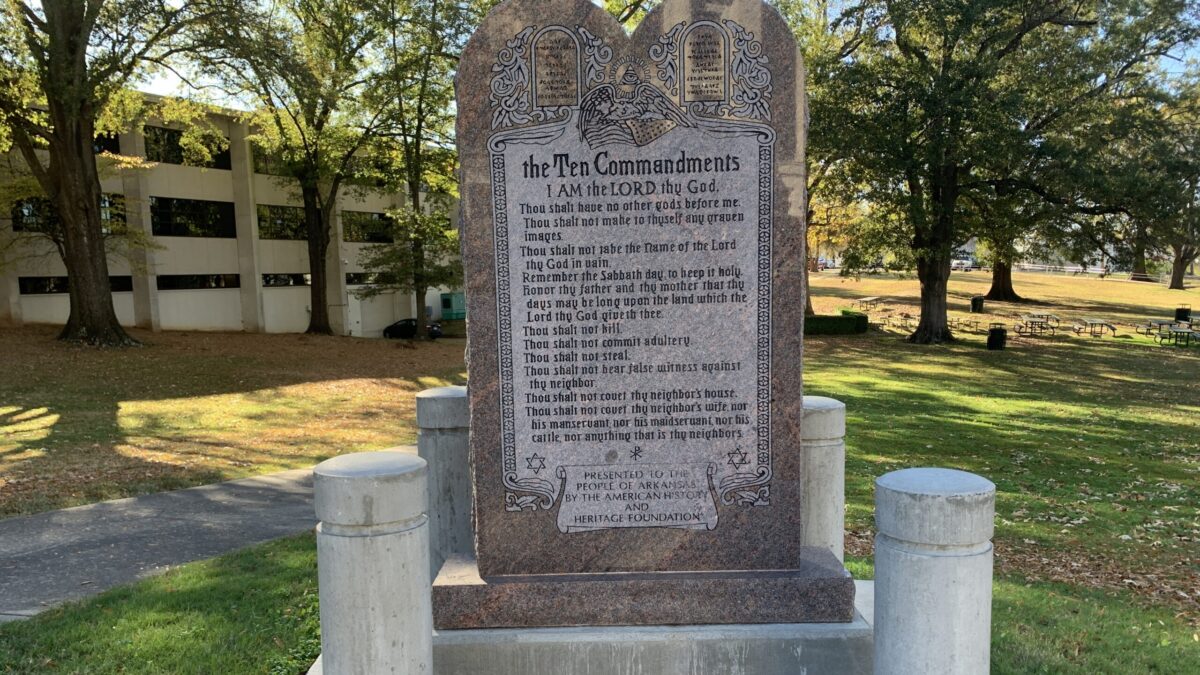
WASHINGTON – Two secular groups have filed an appellate court brief asking for a district court ruling against an Arkansas Capitol Ten Commandments monument to be affirmed.
The Arkansas General Assembly passed Act 1231 in 2015 (the “Display Act”) mandating that the state place a monument “commemorating the Ten Commandments” on the Capitol grounds, using a specific, state-sanctioned version of the Ten Commandments. Christians, Jews, other persons of faith and nonbelievers objected to the placement of the monument at public hearings. Still, despite widespread objections and public controversy, the state installed the monument, which has brought nothing but division to the people of Arkansas.
After reviewing the record, expert reports and motions for summary judgment, the U.S. District Court for the Eastern District of Arkansas held the Display Act and resulting Ten Commandments monument unconstitutional under the First Amendment’s Establishment Clause. The district court considered relevant historical practices and understandings and the relevant context of the Ten Commandments monument in reaching its holding. The Freedom From Religion Foundation and the American Humanist Association are asking the 8th U.S. Circuit of Appeals to affirm the decision.
“On the merits, the district court correctly concluded that the Display Act and the Ten Commandments monument violate the Establishment Clause,” states the brief. “Under the two-step ‘historical practices and understandings’ test there is no established history supporting the specific practice at issue — neither laws ratifying the Ten Commandments nor monuments commemorating them — and no other relevant historical practices that support the challenged practice.”
From the Display Act’s introduction through the monument’s eventual erection, the bill sponsor, media and the public at large have always understood the monument to be religious in nature, the brief points out. Members of the public have consistently opposed the bill on those grounds. The primary sponsor of the Display Act, then-state Sen. Jason Rapert, repeatedly flaunted the religious motivations behind his actions.
The Orsi Plaintiffs are a group of concerned Arkansas citizens who object to the Display Act as a violation of their sincerely held beliefs. Each plaintiff showed that they repeatedly visited the Arkansas Capitol and Capitol grounds for a variety of reasons, both before and after the Ten Commandments monument was installed, and that some of those visits have involved unwelcome contact with the monument. The district court correctly held that the Orsi Plaintiffs have standing to challenge the Display Act and the monument because of their direct, unwelcome contact with the monument. The state’s argument that they lack standing must be rejected.
The principal problem with the state’s examples of generalized religious acknowledgments to justify the monument is that none are analogous to the practice at issue, which ratifies a specific religion’s doctrine. When viewed in relation to these supposedly analogous practices, the uniquely problematic nature of the Display Act becomes clear: Unlike general acknowledgments of religion that have historically been found permissible, here the state has ratified a specific version of a religious code, elevated that version of the Ten Commandments as the state’s officially codified version, and placed the force and authority of the state behind that religious doctrine by memorializing it in a permanent, stand-alone monument.
“For these reasons, this court should affirm the grant of the Orsi Plaintiffs’ summary judgment motion and denial of the state’s summary judgment motion,” the brief concludes.
“The state of Arkansas has no business weighing in on quintessentially religious matters,” notes Freedom From Religion Foundation Legal Counsel Sam Grover. “The Display Act was passed in order to commemorate a literal bible verse that mandates worshiping the Christian god. Erecting a permanent monument to one religion’s beliefs is precisely what our Constitution’s First Amendment was meant to prohibit.”
“The district court was right: Arkansas’s Ten Commandments monument is an unequivocally sectarian display with no deep roots in American tradition, and it has divided the state, telling Arkansans who don’t share the state’s preferred religious views that they are outsiders in their own capitol,” says American Humanist Association Legal Director Amitai Heller. “We will continue fighting against attempts by Christian nationalists to use the power of government to impose their beliefs on everyone else, because religious freedom belongs to all of us.”
The American Humanist Association (AHA) works to protect the rights of Humanists, atheists, and other nontheistic Americans. The AHA advances the ethical and life-affirming worldview of Humanism, which — without beliefs in gods or other supernatural forces — encourages individuals to live informed and meaningful lives that aspire to the greater good of humanity.
The Freedom From Religion Foundation is a U.S.-based nonprofit dedicated to defending the constitutional principle of separation between state and church and educating the public on matters relating to nontheism. With approximately 40,000 members, FFRF is the largest association of freethinkers (atheists, agnostics and humanists) in North America. For more information, visit ffrf.org.
FFRF would also like to thank local counsel Gerry Shulze, who also assisted in the drafting of this brief.
###
The American Humanist Association
The American Humanist Association (AHA) works to protect the rights of Humanists, atheists, and other nontheistic Americans. The AHA advances the ethical and life-affirming worldview of Humanism, which—without beliefs in gods or other supernatural forces—encourages individuals to live informed and meaningful lives that aspire to the greater good of humanity.
Press Contact
Related News
Press Releases
New Federal Voucher Regulations a Christian Nationalist Cash-Grab
Press Releases
American Humanist Association Formally Recognizes Staff Union
Press Releases