humanist values
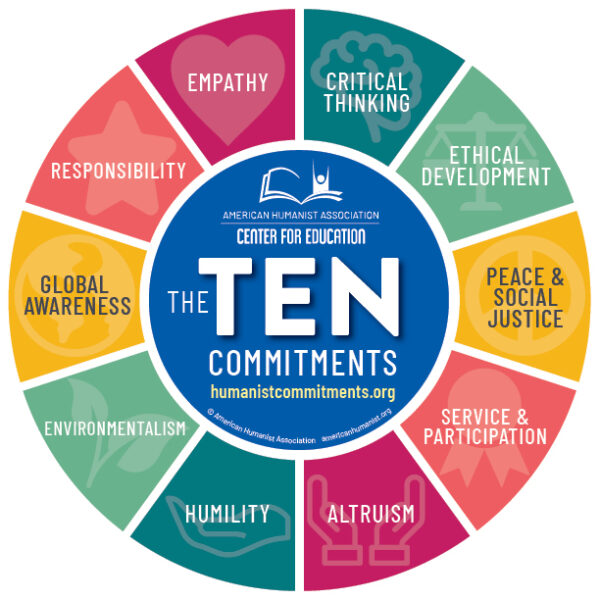
The 10 Commitments
Our shared Humanist values and principles, in an easy-to-understand framework.
These Commitments strive to promote a world in which every individual’s worth and dignity is respected, nurtured and supported, and where human freedom and ethical responsibility are natural aspirations for everyone.
Altruism
“I will help others in need without hoping for rewards.”
Altruism means caring for others without hoping for a reward. Also known as: doing good for goodness’ sake!
Altruism is a foundational value for Humanists, who seek to relieve suffering through compassionate action. Caring for those around us strengthens our connections and contributes to the well-being of society as a whole.
Critical Thinking
“I will practice good judgment by asking questions and thinking for myself.”
We’re surrounded by more information than ever. Critical thinking gives us the tools to evaluate that information, form sound judgments and find effective solutions. This kind of rigorous reasoning is the foundation of the scientific method, driving discovery through hypothesis and experimentation.
Critical thinking is also a skill that grows with practice. Developing it helps us recognize bias in ourselves and others, and builds the open-minded perspective needed to engage with a diverse world.
Empathy
“I will consider other people’s thoughts, feelings and experiences.”
Empathy is the ability to understand another person’s thoughts, feelings and circumstances from their point of view.
It is also the foundation of ethical behavior. When we genuinely understand how our actions affect others, we respond with better judgment and greater compassion.
Practicing empathy strengthens relationships and makes us more engaged citizens, both locally and globally.
Environmentalism
“I will take care of the Earth and the life on it.”
Regardless of who we are or where we live, every person depends on Earth’s ecosystems to survive – and those ecosystems depend on us to take care of them.
Human activity has caused significant harm to the natural world, but humanity is equally capable of healing it. Recognizing that all life on this planet is interconnected is the first step toward becoming better stewards of it.
Ethical Development
“I will always focus on becoming a better person.”
From an early age, we encounter moral questions around fairness, cooperation and how we treat others. Many of these feel intuitive at first, but each stage of life brings new challenges.
That is why ethical development is a lifelong process. Humanism asks us to regularly reflect on our choices, consider their impact on others, and keep refining our values with the goal of becoming better humans.
Global Awareness
“I will be a good neighbor to the people who share the Earth with me and help make the world a better place for everyone.”
Global awareness means broadening our understanding beyond our own experience to include culture, histories and perspectives different from our own in the U.S. It also means recognizing how social, political and economic systems connect us all, and how our choices participate in those systems – for better or worse.
Humility
“I will be aware of my strengths and weaknesses, and appreciate the strengths and weaknesses of others.”
Humility is not about thinking less of yourself. It means having an honest, clear-eyed understanding of who you are – your merits and your faults.
That kind of self-awareness makes it easier to set aside pride, appreciate others genuinely, and feel gratitude for what we have. It grounds us in a simple but important recognition: no person is inherently better or worse than anyone else.
Peace & Social Justice
“I will help people solve problems and handle disagreements in ways that are fair for everyone.”
Peace requires an active commitment to social justice and a genuine respect for the rights and autonomy of every person.
Where injustice exists, conflict exists. Restorative justice – a process of conflict resolution focussed on repairing harm and building a fair, equitable society – offers a path forward for achieving lasting peace.
Central to that process is listening to those whose rights have been violated, and making sure they have the greatest say in determining the path forward.
Responsibility
“I will be a good person – even when no one is looking – and own the consequences of my actions.”
Every choice we make has consequences – for ourselves and for the people around us. Moral responsibility means owning those choices consciously, and being accountable for what follows. Humanism asks us to make decisions with care, and to honestly accept the credit or blame for how they play out.
Service & Participation
“I will help my community in ways that let me get to know the people I’m helping.”
Values only matter when they are put into action. Service and participation is how our convictions, like altruism, come to life in our communities and in the world.
In addition to helping others, those who volunteer or engage in service gain new skills, broader perspectives, and a sense of personal fulfillment that contributes to their own growth.
We Believe in Good
Your support helps us fight for a more compassionate world and better future for everyone.